
Sub-Total: $0.00
Full Spectrum: Defense Technology
Full Spectrum: Defense Technology
Why the money for defense arrived before the factories did.
Budgets and buyers, sensors, electronic warfare, networks, missiles and munitions, air and missile defense, hypersonics, drones, aircraft, land and naval systems, space, cyber and AI, the deterrent, materials, factories, supply chains, the companies, exports, regulation, economics and what recent wars have changed, worldwide. Argues that budgets now outrun the production lines that have to fill them, and that value is moving to sensors, networks, software and sustainment. Comes with a reference workbook of assumptions, sources, method and working calculators, and a live forecast model of world defense equipment spending through 2035, with three cases side by side and every driver an input you can change.
Description
Full Spectrum: Defense Technology
Why the money for defense arrived before the factories did.
An institutional volume on the whole defense technology industry, worldwide, with the United States, NATO Europe and the Asia Pacific allies in depth. It opens with the industry, then works through the products and the customers who buy them, how the industry works from budget request to delivered capability, and the technologies and architectures underneath. Sensors, electronic warfare, command and communications networks, missiles and precision munitions, artillery and ammunition, air and missile defense, hypersonic weapons and defenses, uncrewed systems and autonomy, combat aircraft and rotorcraft, land systems, naval systems and shipbuilding, space, and cyber, software and AI each get their own chapter, as does the strategic deterrent enterprise. Then materials and critical inputs, manufacturing and capacity, the supply chain, the companies, new entrants and how capital reaches them, geography and trade, arms exports, operations and sustainment, regulation and market access, demand, costs and pricing, what recent wars have changed, innovation, and the forecast. Every chapter opens on a drawn process flow, and the shaded maps place the industry country by country.
The volume argues from five conclusions. The money arrived before the factories did: budgets now fund several years of what the production lines deliver. Growth has moved to Europe and Asia. Cheap mass now meets the exquisite, and the cost exchange decides who can keep firing. A handful of chokepoints, from solid rocket motors to rare earth refining, gate the whole chain. And value is moving from platforms to sensors, networks, software and sustainment.
The reference workbook.
Built to be used rather than read. The scope, taxonomy and definitions the volume relies on, every assumption flagged with its basis and the page it supports, the companies with their roles, every source, and working calculators, with the arithmetic shown wherever nothing is published.
The forecast model.
World defense equipment spending, procurement plus research and development, through 2035 in constant dollars, built region by region, with units held against production line capacity for the programs that set the pace. Low, Base and High are computed side by side rather than toggled, and a sensitivity tab shows which input moves the answer most. The formulas are live: every driver is an input you can change, and the model recomputes.
You receive: the volume as a PDF and as a PowerPoint, the reference workbook, the forecast model, and a slide by slide guide to the volume.
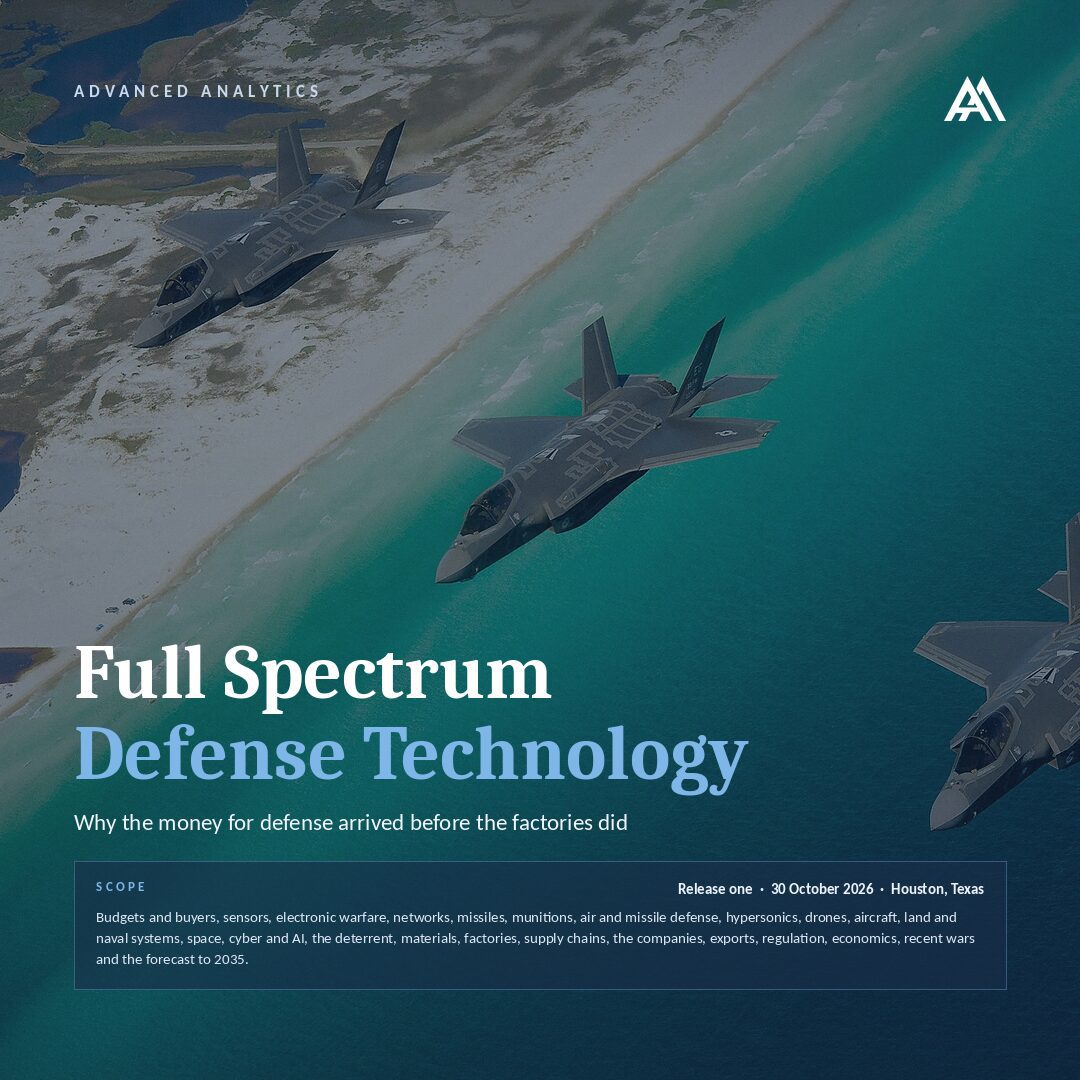
Tile photograph: U.S. Air Force F-35A Lightning II aircraft in formation near Eglin Air Force Base, Florida. MSgt John Nimmo Sr., U.S. Air Force, via Wikimedia Commons, public domain.
Reviews
There are no reviews yet.