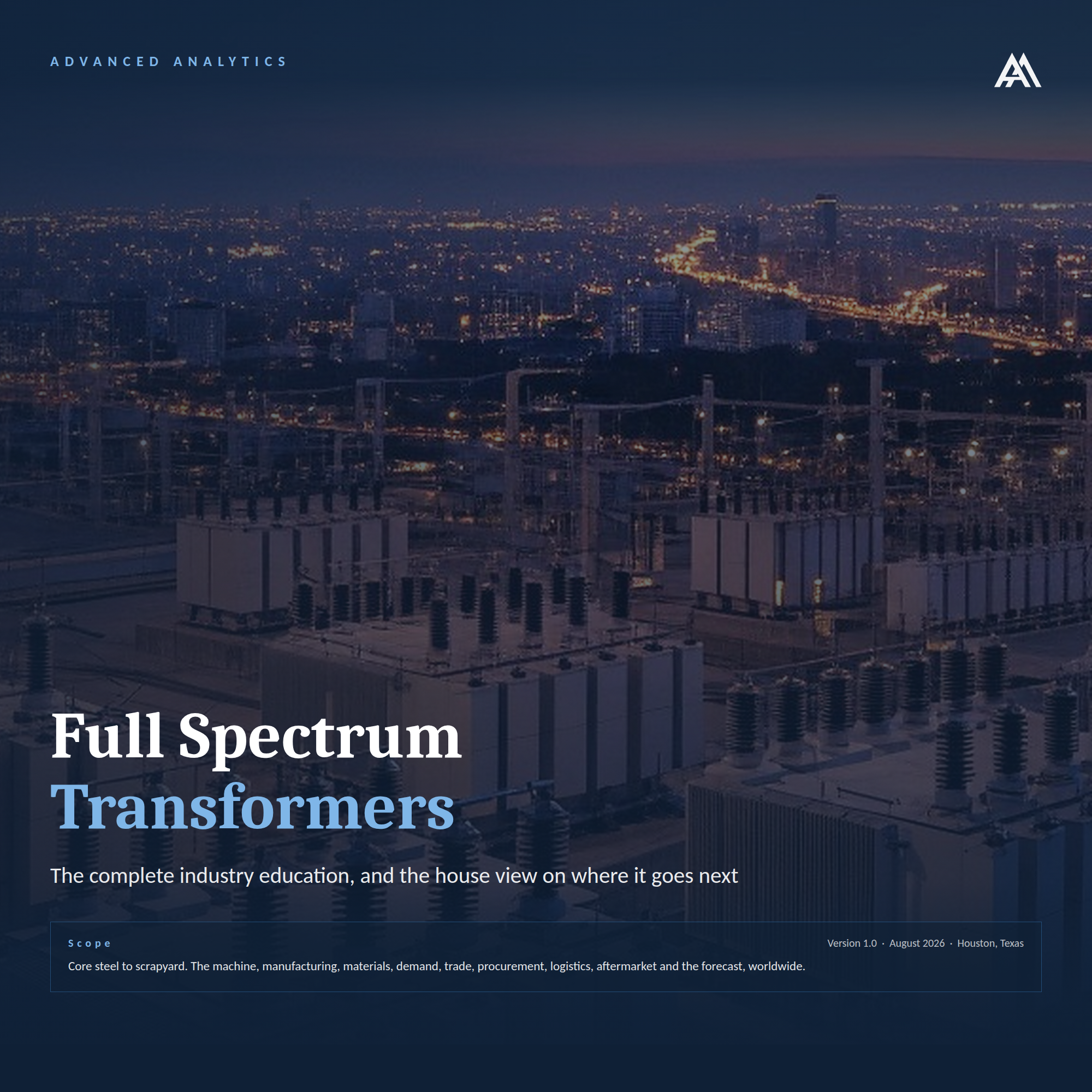
120 pages. 19 chapters. 93 exhibits.
An institutional volume on how the transformer industry actually works. The machine and what is inside it, where it sits in the grid, how one is built and why that is slow, the materials that set the ceiling, what is pulling demand and how hard, the market sized in units and in dollars, who makes them and where, the economics and who captures the cost, trade and tariffs, how utilities actually buy, operations and lifecycle, whether the thing can physically reach the site, aftermarket and what is recovered at the end, the technology of the next decade, and the house view on the cycle, the winners and the risks. Includes sixteen company profiles and a manufacturer census.
Ships as one complete file, as a PowerPoint and as a bookmarked PDF.
The reference workbook. 30 tabs.
Built to be used rather than read. Nine working calculators plus the reference tables an engineer reaches for, sitting alongside the manufacturing, materials and economics chapters: loss evaluation and total cost of ownership, loading and aging, ratings and class boundaries, insulating liquid classes, and the heavy haul difficulty index the logistics chapter is built on. Every chart in the volume is indexed to the data behind it.
The forecast model. 17 tabs. 2025 to 2035.
A bottom up model with 879 live formulas. Power transformers built from capacity, distribution transformers built from units, dry type carried at the top down residual and labeled as such rather than dressed up as a third build. Ten inputs carry the whole forecast, each with its honest low, mid and high width and its confidence class stated, including which input is the weakest. Bear, base and bull are computed side by side, not toggled: $100.9bn, $131.2bn and $160.3bn in 2035 against a $62.9bn base in 2025. Every lever is an input you can change, and the model recomputes. Chapter 18 publishes the model tab by tab, so every figure in the document traces to the arithmetic that produced it.
You receive: the volume as a PDF and as a PowerPoint, the forecast model, the reference workbook, and the source register.


Reviews
There are no reviews yet.